अर्थ प्रणाली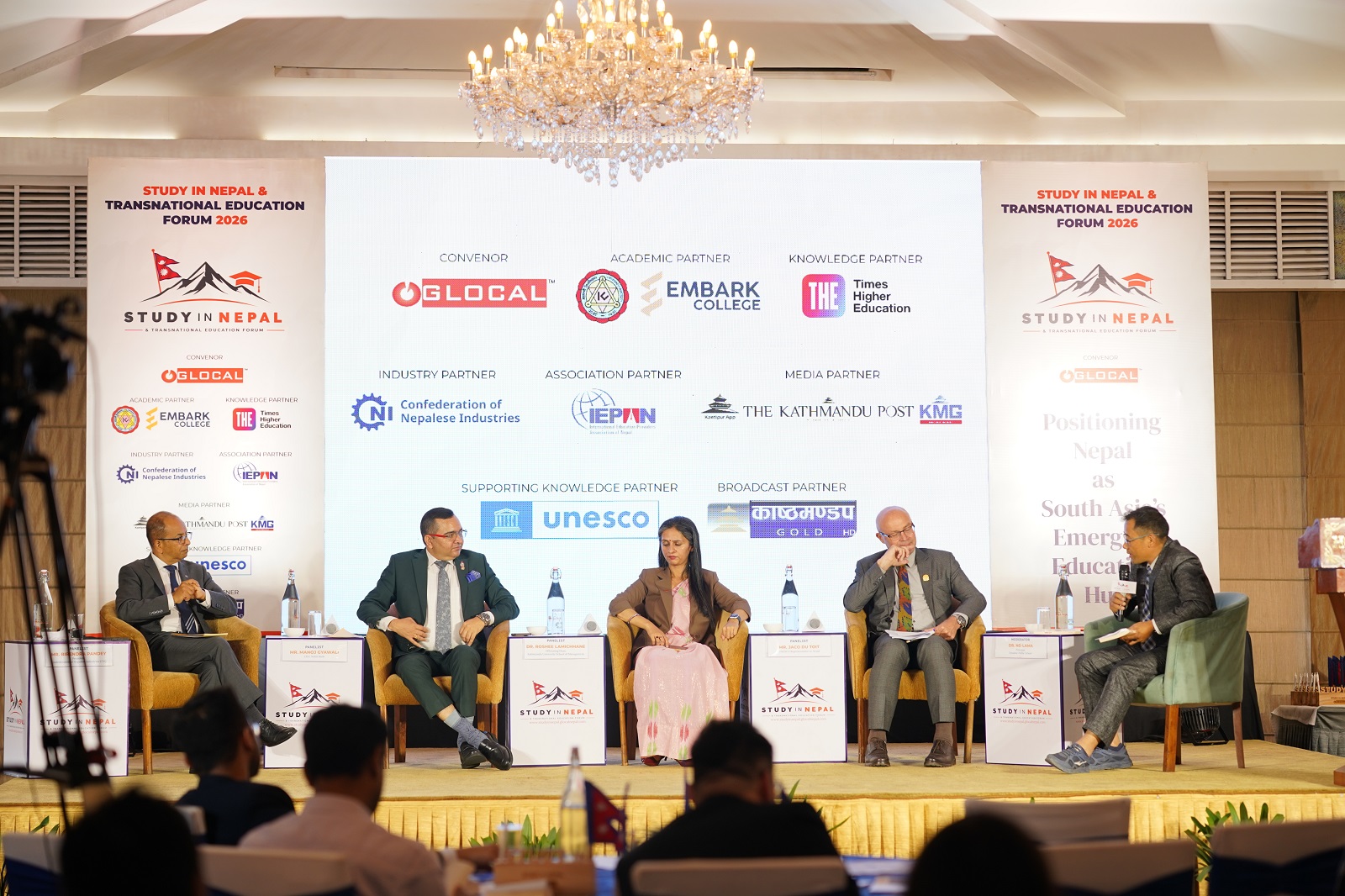

KATHMANDU, NEPAL . The Study in Nepal & Transnational Education (TNE) Forum 2026 successfully concluded today at the Hotel Himalaya in Kupondole, Lalitpur. The event brought together international diplomats, educational leaders, business experts, and policymakers to discuss how to improve higher education in Nepal, bridge the graduate employability gap, and connect the nation with global academic standards.
The forum was hosted by Glocal Pvt. Ltd. in partnership with a strong network of organizations, including Academic Partners Kathmandu University and Embark College, Knowledge Partner Times Higher Education (THE), Supporting Knowledge Partner UNESCO, Industry Partner Confederation of Nepalese Industries (CNI), Association Partner IEPAN, and Media Partners The Kathmandu Post and Kantipur Media Group (KMG).
Throughout the day, speakers and panelists focused on finding practical ways to shift Nepal from a traditional source country for outbound students into a top choice for learners from neighboring countries and around the world.
Key Highlights from the Event:
● Global Education Trends & Keynotes: The morning started with a presentation by Mr. Ashley Mok from Times Higher Education, who talked about global education trends and how Nepal fits into South Asia. Attendees also heard from top leaders at Kathmandu University, including Vice Chancellor Prof. Dr. Rishikesh Wagle and Economics Professor Prof. Dr. Achyut Prasad Wagle.
● Mr. Parshu Ram Tiwari, Under Secretary of the Ministry of Education, Science and Technology, was also present at the event, sharing his special remarks on the concept of Transnational Education (TNE), its acceptance in Nepal, and the support provided by the Government of Nepal to foster the sector.
● Panel 1: Nepal as a Regional Education Hub: Led by Mr. Asish Thakur (Chairman, Glocal Pvt. Ltd.), this discussion focused on how to attract international students. Speakers included H.E. Rob Fenn (British Ambassador to Nepal), Mr. Greg Klemm (Deputy Head of Mission at the Australian Embassy), Ms. Shailaja Adhikary (CEO & MD, IEC College), and Prof. Dr. Mahanand Chalise (Registrar, Tribhuvan University).The panel concluded that transforming Nepal into a credible regional education hub requires building a collaborative ecosystem that bridges international best practices with local policy reforms. To successfully attract international students, Nepal must establish streamlined regulatory frameworks, transparent credit transfers, and robust quality assurance that aligns with global standards.
● The Voice of Students: To make sure student needs are a priority, two students shared their perspectives: Mr. Xudong Shi (Kathmandu University School of Education) and Ms. Sabrina Thapa (MBA student, Embark College).
● Panel 2: Education Quality and Jobs: Moderated by Dr. ND Lama (Principal, Dynamic Public School), this afternoon session focused on matching college education with actual career needs. Panelists included Mr. Jaco du Toit (UNESCO Representative to Nepal), Mr. Birendra Raj Pandey (President, CNI), Mr. Manoj Gyawali (CEO, Nabil Bank), and Dr. Roshee Lamichhane (Officiating Dean, Kathmandu University School of Management), was ended with a learning that” By focusing on KASH (Knowledge, Attitude, Skills, and Habit), educational institutions can realign their curricula to not only impart theoretical understanding but also foster the practical capabilities and workplace mindsets that industries urgently require, effectively bridging the graduate employability gap.”
● Closing Reflections: The event wrapped up with a summary from Prof. Dr. Hem Raj Kafle (Director of Academic Excellence, Kathmandu University).
Shifting the Narrative: From Labor to Knowledge
Opening the forum, Mr. Asish Thakur, Chairman of Glocal Pvt. Ltd., emphasized that the gathering was a strategic national conversation regarding Nepal’s economic and academic positioning. Highlighting the significant financial and talent brain drain caused by the current outbound student flow, Mr. Thakur stressed the urgency of strengthening Nepal’s internal higher education ecosystem.
“A nation does not become a knowledge economy by chance. It becomes one through vision, systems, collaboration, and consistency. We must have the courage to believe that Nepal can contribute to the world not only through labor and tourism, but also through knowledge, research, innovation, and education.”
Mr. Thakur shared that Nepal’s TNE ecosystem is already robust, with roughly 56 providers engaging over 34,000 students. In the fiscal year 79/80 alone, the sector contributed NPR 248 million in income tax and over NPR 15 million in student regulatory fees. He noted that while Nepal may not compete globally on a physical scale, it can excel through affordable, quality-focused partnerships, digital learning ecosystems, and niche specializations. To demonstrate this shift, he highlighted Glocal’s own initiative in developing global online learning courses for a university in Thailand, proving Nepal can step up as a contributor—not just a consumer—of international education.
A Concrete Call to Action: The Joint Leadership Committee
Closing the five-hour event, Ms. Kajol Jha, Managing Director of Glocal Pvt. Ltd., delivered a passionate vote of thanks and closing address. She reflected on the forum’s core question: whether Nepal can truly reclaim its ancient legacy as a place where seekers come for transformation and wisdom.
Ms. Jha announced that the forum achieved a major, tangible breakthrough: the formation of a Joint Leadership Committee.
“This committee does not exist as a footnote, but as this gathering’s lasting outcome. Its mandate is clear: to ensure the candid conversations held here today regarding streamlined accreditation, transparent credit recognition, and regulatory stability are directly translated into the national policies that matter.”
Addressing the students in attendance, Ms. Jha reminded the audience that students are not merely beneficiaries, but the very purpose of these educational reforms. She concluded with a firm commitment to return next year with measurable outcomes, deeper partnerships, and a stronger coalition dedicated to proving that “Study in Nepal” is a long-term national direction rather than a mere slogan.
By opening up critical discussions on international university partnerships, teaching quality, policy alignment, and job readiness , the Study in Nepal & Transnational Education Forum 2026 has set a clear path toward establishing a sustainable knowledge economy for the country.