अर्थ प्रणाली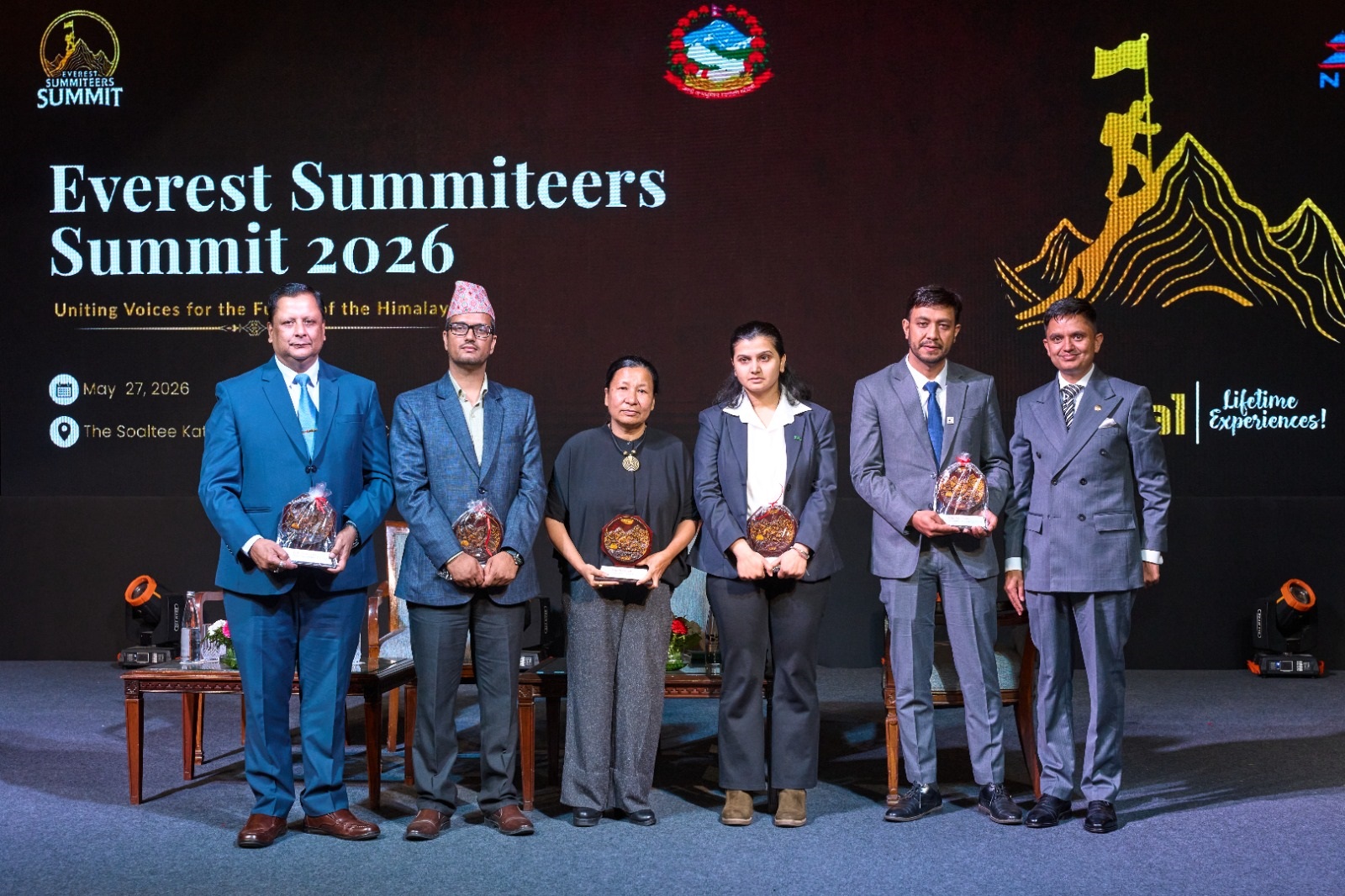
KATHMANDU . On the occasion of the 73rd anniversary of the first summit of Mt Everest by Sir Edmund Hilary and Tenzing Norgay Sherpa, Nepal hosted a gathering of over 176 Everest summiteers from 26 countries to unite voices for the future of the Himalayas.
In a landmark show of collective responsibility, the present alpinists signed a pledge committing to sustainable and ethical mountaineering. The signatories vow to raise awareness about climate change and its impact on glaciers, mountain ecosystems, and local communities, while actively supporting environmental action and advocating for sustainable mountaineering practices in every expedition they undertake, weather in Nepal or in their respective countries.
During the Everest Summiteers Summit 2026 held on May 27, the Right Honourable President of Nepal, Ramchandra Paudel, who interacted closely with Nepali and international climbers, emphasised the crucial need for preserving Mount Everest (Sagarmatha) and called for urgent international cooperation to counter the severe impacts of global warming, glacier melt, and biodiversity loss in the region. “Sagarmatha [Mt Everest] is not only a geographical identity of Nepal, but also the prestige, pride of the entire country, and the world’s invaluable natural heritage.
It is a well-known fact that the conservation, promotion, and balanced use of this heritage have contributed significantly to Nepal’s economy through its tourism sector. However, problems such as global warming, the impact of climate change, and garbage accumulation in the mountainous areas have become a great challenge,” President Paudel said. He further shared, “By solving these problems, further efforts and cooperation are needed today to make mountaineering safe, sustainable, and technology-friendly, while preserving the ecology and biodiversity of the Sagarmatha region.
Likewise, Minister for Culture, Tourism and Civil Aviation, Khadga Raj Paudel, praised the courage and determination of the summiteers and stressed the need to promote safe and sustainable mountain tourism. He emphasized improving climber safety, strengthening emergency rescue systems, and empowering local Himalayan communities economically. He also expressed concern over the serious effects of climate change in the Himalayan region, accelerating glacial melt, loss of biodiversity, and growing waste management challenges, stating that Himalayan conservation is a shared global responsibility, not Nepal’s alone.
“Today, we also witnessed the Oath Taking Ceremony of Everest Summiteers a deeply symbolic and meaningful moment that reflects collective responsibility, discipline, integrity, and commitment toward the mountains and future generations. This oath reminds us that every ascent carries not only personal ambition, but also a profound duty: to protect the dignity of mountaineering, preserve the fragile Himalayan environment, support fellow climbers, respect local cultures and communities, and uphold the values of safety, humility, solidarity, and responsible adventure,” Minister Paudel said.
“The Government of Nepal, through the Ministry of Culture, Tourism and Civil Aviation, remains firmly committed to strengthening responsible and sustainable mountain tourism, promoting climber safety, improving rescue and emergency response systems, preserving Himalayan ecosystems, empowering local mountain communities, and ensuring that tourism contributes meaningfully to sustainable livelihoods, economic prosperity, and national development. We deeply value the immense contributions of our mountaineering community guides, Sherpas, climbers, rescue professionals, expedition organizers, researchers, conservation partners, tourism entrepreneurs, and local communities whose dedication, professionalism, and resilience continue to strengthen Nepal’s position as a global center for mountaineering and adventure tourism,” he added.
The climbers from 26 countries who successfully scaled the world’s highest peak were honored with special medals and certificates of distinction. Among the distinguished honorees were legendary icon Kami Rita Sherpa, who recently scaled Everest for the 32nd time. Mr. Sherpa was awarded with Lifetime Achievement Award- which is the biggest and grand award of the Everest Summiteers Summit, for his courage, dedication, and contribution to Himalayan mountaineering which continues to inspire the world. The summit also hosted three separate panel discussions.
The first panel discussion, titled Women in Mountaineering: Safety, Dignity and Equal Opportunity, was moderated by Ms. Billi Bierling alongside panelists Ms. Lakhpa Phuti Sherpa, Ms. Alessandra Pepper, Ms. Adriana Brownlee and Ms. Julia Hamilton. The panel highlighted the skyrocketing numbers of women who have summited Mt Everest over the last few decades. The panelists emphasized that women were able to better perform on higher altitudes with better preparation and acclimatization. They also called for the importance of personal responsibility in every expedition. Likewise, the panel Summit Perspectives: Risk, Resilience and Achievements saw panelists Mr. Nashu Mahruki, Mr. Arjun Vajpai, Mr. Shehroze Kashif, Mr. Nathaniel Douglas, and Mr. Gelje Sherpa share concerns over safety in higher altitudes following the increase in the number of inexperienced people taking on Everest each year, and called for stricter regulation to control crowds above the death zone. Emphasis was also laid on setting up rescue camps at Camp IV to minimize further casualties on Everest, manage waste and strengthen policies and programs to effectively tackle the impacts of climate change in mountain regions.
The third panel; Scaling Climate Finance for Mountain Ecosystem was moderated by Dr. Anu Lama alongside panelists; Mr. Yuwa Raj Guragain, Environmental professional and Climate Change, Safeguards and Gender Focal Point at IUCN Nepal, Mr. Rajan Thapa, National Project Manager for the GEF-funded CBIT project at WWF Nepal, Dr. Manish Raj Pandey, Director and Head of the Climate Change Department at NTNC, and Ms. Asmita Pandey, Safeguarding and Communication Officer at the Zoological Society of London Nepal Office. The panel discussion called on the need to amplify the message that climate finance is not just a climate challenge; it is an investment for the sustainable future of the people, mountains, and the population living downstream. Stating the vulnerability of the mountains, emphasis was laid that mountains will no longer be seen as too difficult to finance, but too difficult to ignore.
During a separate session, Everest Alliance Nepal and China-based GoNature Outdoor Sports Group Co., Ltd. have signed a Memorandum of Understanding (MoU) to establish and sponsor the “Everest Summiteers Summit Award 2027,” featuring a USD 30,000 cash prize for outstanding individuals, organisations and global mountaineers for their contribution in mountainnering and community development, with the award to be officially announced during the 3rd Everest Summiteers Summit 2027 in Nepal.